
Red, yellow, green, blue? Why your colour is where DISC starts, not where it ends
Your DISC colour tells me how you like to work, but it tells me nothing about how you land with the people around you.
Why I keep banging on about this
I love that DISC has gone mainstream. These days, when I walk into a workshop, someone has usually done a free quiz the night before, announced they’re “a red” and is half expecting me to confirm they’re allowed to be blunt.
Here’s my problem with that. The colours were only ever meant to be the starting point. Somewhere along the way they turned into a label, an excuse and, honestly, a bit of a party trick. “Sorry, I’m a high D, that’s just how I am.” “Don’t give me the detail, I’m yellow.”
The moment your colour becomes your identity, it stops being useful. That’s why we talk about this so much at DISC Academy. DISC is widely used, but rarely mastered, and this is exactly where the mastering starts. Your style describes your preferences. It doesn’t decide your behaviour. You do.
What it costs you to stop at the colour
When you stop at the colour, a few things quietly happen. People get boxed in (“we can’t put her on that project, she’s a C”). Behaviour gets excused instead of examined. Real tension gets written off as a “personality clash” when it’s actually a conversation two adults could have. And the workshop everyone loved turns into an in-joke by Friday.
Go one step further and it’s a different story. You stop asking “what colour are you?” and start asking “how is my style landing right now, and what does this person need from me?” That’s where the good stuff shows up: fewer misunderstandings, feedback that actually lands, meetings where the quiet ones speak up, and leaders who flex instead of steamroll.
What the research says
Organisational psychologist Tasha Eurich ran a research program across ten studies and nearly 5,000 people. About 95% of them believed they were self-aware. Her team estimated only 10 to 15% actually were.
Sit with that for a second. Most of us are walking around with a confident, and not quite accurate, picture of how we come across. Her research also separates knowing yourself from knowing how others see you, and found the two barely relate. A colour on its own doesn’t close that gap. Knowing your style and knowing your impact are two different things.
“Everything that irritates us about others can lead us to an understanding of ourselves.”
Carl Jung
Same colour, different impact
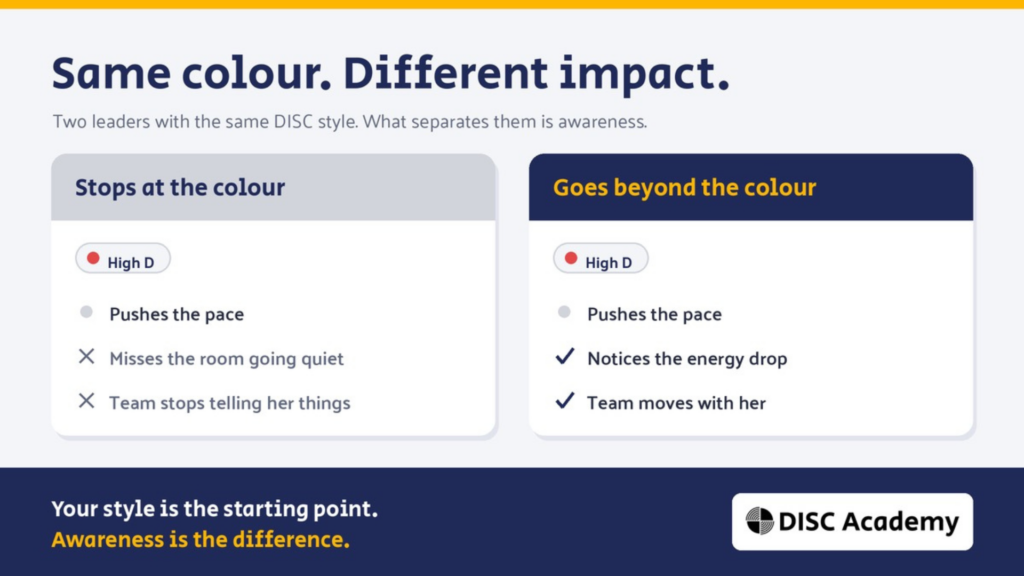
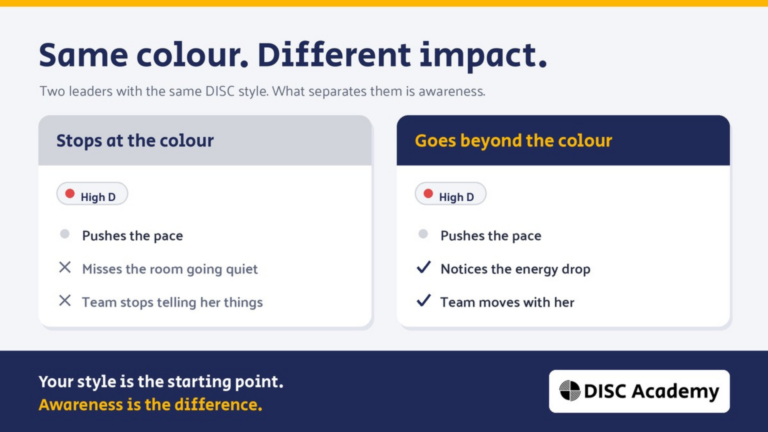
Let me paint a picture you’ll probably recognise. Two team leaders, both with a strong D style. Both direct, fast and all about results.
The first one runs her meeting like a sprint. Decisions get made, ticks go on the list. What she doesn’t notice is that two people have gone quiet, and one of them heads straight to the kitchen afterwards to vent. Her team calls her efficient. They also stop telling her things.
The second one is just as direct. Same pace, same drive. But halfway through she clocks that the energy in the room has dropped. She stops and says, “I’ve been doing all the talking. What am I missing?” Her team still moves fast. They just move with her.
Same colour. Completely different impact. The difference isn’t their style. It’s how aware each of them is of herself, and of the people around her.
So what does this mean with Discflow and DISC Academy?
This is exactly why Discflow is our diagnostic of choice. DISC Academy is an Official Discflow Partner, authorised to deliver Discflow’s behavioural assessment and development tools. Discflow combines DISC behavioural styles with Emotional Intelligence to help people and teams communicate, lead and work together more effectively.
In plain English: your colour is only half the story, and the other half is exactly what separated our two team leaders. If you want the full picture, Core 2.0 is where most people start: the flagship Discflowprofile: DISC behavioural styles and Emotional Intelligence in one integrated report.
And we don’t hand you a report and wave goodbye. At DISC Academy we unpack it with you, one on one or as a team, so the insight turns into something you actually do differently on Monday.
Five ways to go beyond your colour this week
- Swap “I am” for “I tend to”. “I’m a high I” becomes “I tend to think out loud.” It sounds small. It changes how you and everyone else hear it.
- Ask one person how you land. Pick someone you trust and ask, “When I’m under pressure, what do you notice?” Then just listen. No defending.
- Use the Jung test. Next time someone irritates you, ask what they might need that you’re not giving them, and what your reaction says about you.
- Flex for one conversation. If you’re fast, slow down for your steady colleague. If you live in the detail, lead with the big picture for your results-driven boss.
- Get the full picture, not just the colour. A colour label is a fun start. A proper profile and a good debrief are where it gets useful.
Your next step
Leave a comment or get in touch.
Ready for more than the colour? Have a look at our DISC reports for yourself or your team, or get in touch about a team workshop and we’ll unpack it together.